How to Spot Flood Damage in a Used Car: 8 Signs
How to Spot Flood Damage in a Used Car: 8 Signs
Let me be blunt: flood-damaged cars are a plague on the used car market, and they’re not going away anytime soon. After every major hurricane (Harvey, Ida, Ian), tens of thousands of water-logged vehicles get dried out, cosmetically cleaned up, and quietly pushed back into circulation. Some end up at salvage auctions with honest titles. A lot of them don’t.
The National Insurance Crime Bureau estimated that Hurricane Harvey alone put roughly 500,000 flood-damaged vehicles into the pipeline. The ones that stayed in Texas were easy enough to track. The ones that got shipped to Ohio, Nevada, or Georgia? That’s where the trouble starts.
I’ve been buying, inspecting, and sometimes regretting used cars for about fifteen years. Flood damage is the one thing I’m most paranoid about, because it’s also the one thing that’s designed to hide from you. A good detail job and a fresh pine air freshener can fool almost anyone on a casual walkthrough. A car that ran fine for six months after a flood can present as completely normal at a 30-minute showing. This guide is for people who want to do better than casual.
How Flood Cars Enter the Market
To understand why flood-damaged cars are so hard to catch, you need to understand how they move.
When a car gets totaled by an insurer due to flood damage, it receives a salvage title. That’s the honest outcome. But not every flooded car goes through insurance. Private sellers can dry out a car, make it start, and sell it privately without ever involving an insurer. No claim, no title brand, no record.
The more sophisticated version is title washing. A salvage-titled car gets registered in a state with weaker branding laws (think Montana or Mississippi) long enough to get a clean title issued. Then it moves again. Buyers in the final state often have no idea what they’re looking at. By the time the electrical gremlins start and the floorboards rust through, the seller is long gone.
This isn’t hypothetical. The NICB publishes anti-title washing warnings after every major storm because it happens every single time.
The price point is important too. Flood cars tend to appear at prices that look like a deal. A $14,000 2018 Toyota Camry in a market where comparable examples sell for $19,000 to $21,000 isn’t a bargain; it’s a question. The discount has to come from somewhere, and if the seller can’t explain it clearly, water damage is one of the more likely explanations. Be suspicious of “motivated seller” pricing on cars that otherwise look presentable.
The 8 Physical Signs of Flood Damage
When you go to look at a used car, give yourself at least an hour. Rushing is how you miss things. Here’s what to check, in order of how easy they are to fake:
1. The Smell
Get in the car and close the door. Sit there for thirty seconds with the HVAC off. A musty, mildewed, or earthy smell is your first red flag. It’s hard to eliminate entirely because it settles into foam padding, carpet backing, and the headliner. Sellers know this, which is why you’ll often find cars with dangling pine tree air fresheners or heavy application of Febreze. Both are suspicious when combined with any other sign on this list.
Don’t confuse a musty smell with a dusty one. Dusty smells come from old, dry interiors. Musty smells have moisture at their root. You know the difference.
2. Waterline Marks
Water leaves a tide line as it recedes. Look for this inside the door jambs, along the lower sections of the kick panels, and underneath the dashboard. In the trunk, pull back the cargo liner and look for a horizontal discoloration or staining along the side walls. Even a thorough cleaning often misses these marks in door hinges and seat track channels.
Shine a flashlight horizontally along the lower door panels. Any faint horizontal line or staining is worth asking about.
3. Rust in the Wrong Places
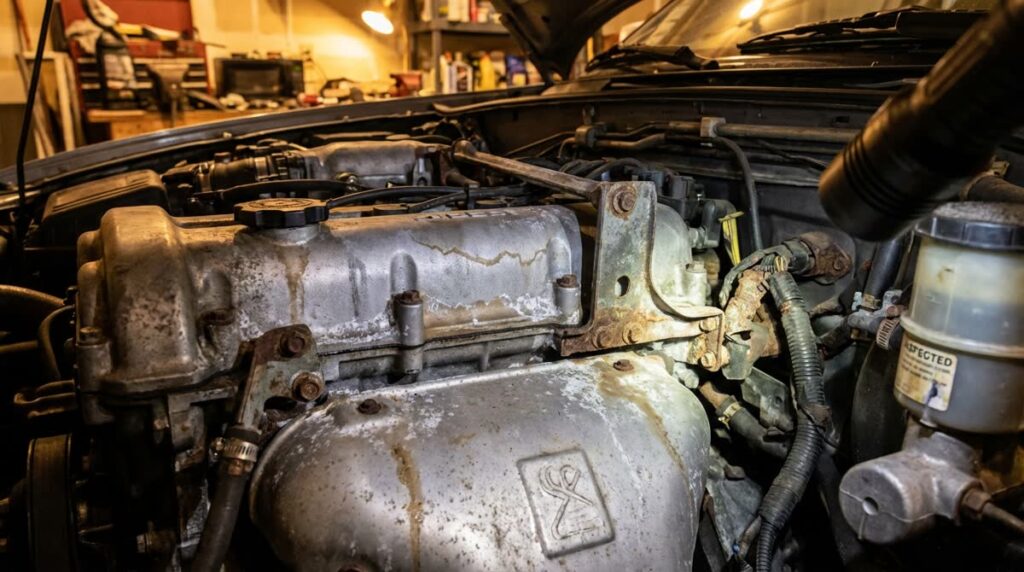
A little surface rust on brake rotors is normal; that happens overnight. But rust on brake lines, suspension springs, or seat frame bolts in places that should be well-protected is abnormal for a car that’s been properly cared for. Pop the hood and look at the battery terminals, the fuse box, and any exposed metal in the engine bay. Accelerated corrosion on components that sit well above the road surface is a meaningful tell.
4. Electrical Glitches
Flood damage is catastrophic for wiring. Water infiltrates connectors, migrates through insulation, and leaves behind mineral deposits that cause corrosion months or years later. During your test drive, cycle through every electrical function: windows, mirrors, heated seats, climate control, infotainment. Check warning lights. A car that had brief electrical problems after flooding will often have them resurface, usually in sporadic and hard-to-diagnose ways.
Ask if there have been any electrical repairs. The answer, or the evasiveness of the answer, is telling.
5. Mismatched Interior Materials
Flood-damaged cars often get partial interior replacements. Someone might replace the soaked carpet but not the headliner. Or swap the front seat foam but leave the original rear seat cushions. Look for color mismatches between sections of carpet, upholstery that doesn’t sit quite right, or trim pieces that are slightly different in shade or texture from the rest of the interior.
New carpet in an otherwise used-looking interior is exactly the kind of detail that should make you ask questions.
6. Foggy or Condensation-Prone Lights
Water gets into headlight and taillight assemblies through the vents and seals. Once it’s in, it leaves calcium deposits on the inside of the lens that you can’t clean off from the outside. It also corrodes the reflector backing over time. A quick look at the interior surface of the lens, ideally with a flashlight, will show either clean reflective surfaces or a cloudy, spotted pattern. Both headlights and taillights are worth checking.
7. Silt and Mud in Crevices
Water carries sediment, and that sediment ends up in places that are nearly impossible to clean properly. Look under the seats (pull them forward and back), inside the spare tire well, in the battery compartment, and along the edges of the engine bay where the hood closes. A thin, dusty residue in locations that should only see dry air is a strong indicator of past flooding.
Be especially suspicious of mud or silt around the base of the windshield where it meets the cowl panel. That area is difficult to access for cleaning.
8. Corroded Wiring and Connectors
If the seller allows it, pull back a section of carpet near the sill plate and look at the wiring that runs along the floor. Corroded pin connectors, green or white oxidation on bare copper, and stiff or brittle insulation all suggest water exposure. Under the dashboard is another good place to look: reach in and feel the wiring harness near the footwell. Healthy wiring should feel supple. Wiring that’s been submerged tends to get stiff and crumbly at the insulation after a while.
Digital Tools to Uncover Water Damage History
Physical inspection catches a lot, but it doesn’t catch everything. A skilled detailer with a few days and a few hundred dollars can obscure most of the signs above on a casual walkthrough. That’s why the physical check and the paper check need to happen together.
Running a vehicle history report gives you access to title records across multiple states, which means you can see if a car was ever branded as a flood loss or salvage before it was retitled somewhere else. You can also see whether the car changed states in quick succession (a common pattern in title washing), whether there were any reported accidents around the same time as a major hurricane, and whether the odometer readings are consistent over time.
A flood-damaged car that never went through insurance won’t show up in a history report. That’s an important limitation to understand. But a car that did go through insurance, received a flood or salvage brand, and was then washed through another state will almost always leave traces in the title chain. That’s the scenario a history report protects against most reliably.
I run one before I do anything else. It takes about two minutes and filters out the most obvious cases immediately.
What to Do If You Suspect Flood Damage
You’ve done the inspection. You’ve found some red flags. What now?
Get an independent pre-purchase inspection. A mechanic who has no relationship with the seller, ideally a shop that specializes in whatever make you’re looking at, can put the car on a lift and see things you can’t see in a parking lot. Budget $150 to $200 for this. That’s cheap compared to buying a $15,000 problem.
Ask direct questions and watch the response. “Has this car ever been in a flood?” is simple enough. A seller who gets defensive, changes the subject, or offers vague answers about “a little water in the floorboards one time” deserves your skepticism. Deliberately concealing known damage to induce a sale is fraud in most states, which doesn’t help you after the fact, but it’s worth knowing where you stand legally.
Use your findings as negotiating leverage. If you’ve found suggestive signs but not definitive proof, you’re not necessarily walking away, but you’re certainly not paying asking price. Be specific: “The passenger seat has what looks like a waterline stain at the base, and I found silt residue in the spare tire well. I’d want an independent inspection before committing, and I’d need the price to reflect that risk.” A seller with nothing to hide usually agrees to the inspection.
Be willing to walk away. This is the hardest part, especially when you’ve driven two hours to look at a car that otherwise seems perfect. Flood-damaged cars are money pits. The electrical problems that surface six months later are unpredictable and expensive. The structural corrosion that develops under the carpet over two or three years can make a car unsafe. And once a flood title gets attached to a vehicle, resale value drops sharply and stays there. You cannot refinish your way out of a flood title at sale time.
There are always more cars. A clean example is worth waiting for, and it’s worth the extra $3,000 or $4,000 compared to a flood candidate priced to look attractive. The math on that becomes very obvious after the first major electrical repair on a water-damaged car.
Quick Reference Checklist
Before you finish any inspection, run through this:
- Smell test (musty/mildew with door closed)
- Waterline marks in door jambs, trunk, kick panels
- Abnormal rust on protected components
- Electrical function check during test drive
- Interior material mismatches
- Foggy or calcium-spotted light assemblies
- Silt/mud in spare tire well, battery area, cowl
- Corroded or stiff wiring along floor sills
- Title history report pulled
- Independent mechanic inspection scheduled
Two or more red flags on the physical list, combined with a murky title history, is usually enough reason to pass. One or two isolated signs warrant more investigation before you commit.
Flood damage is a problem that gets worse over time, not better. The people selling these cars know that. The inspection is your window before the warranty clock runs out on what they know and you don’t.
Article covers signs of flood damage in used cars for prospective buyers performing due diligence before purchase.